.png)


A Universal Cuban
A fascinating retrospective of the Cuban artist Wifredo Lam is at MoMA.
By Alexander Estrada


_edited.jpg)
There was slim, linen-suited Wifredo Lam on the bow of a steamer destined for Madrid, as history slipped beneath the horizon. He was to experience Europe, to let it experience him. It would be twenty years before he returned to Cuba and made his best art, but as his gaze reckoned with what lay ahead, he did not know that. For the continental castaway, travel is as much a project of forgetting as it is the promise of something utterly new.
By force or good fortune, the island of Cuba has a solid stock of wandering peoples. Thinkers, artists, revolutionaries and everyday Cubans have so often been cast from their homes into something of a cliché. For the rootless nostalgic, life abroad is as much a compulsion as it is a pathology, and the concept of home, whatever that is, entails a search for meaning, not only in what remains of the past, but in all that has been forgotten, the empty canvas onto which history can be brushed into sense.
On that last count, Wifredo Lam with his temptingly universal name is now enjoying a sublime retrospective at the Museum of Modern Art (MoMA) in New York City, entitled When I Don’t Sleep, I Dream. He was born near a sugar plantation in 1902 to a Chinese father and half Congolese mother, was partly raised by a Santeria sorceress, and left for Europe at the age of 21. That biography contains almost the whole history of the island.
His art was enigmatic and hard to place, familiar as a face in the queue but otherwise unknowable. He was the Cuban surrealist, a Caribbean Picasso, an Afro-Latino Cubist, sometimes a ceramicist, El Chino, Italophile, lover of poetry and vivid colors and of the sad spirits of the past. He was a universal Cuban.
Was he trying to forget Cuba? The exhibit provides a fascinating answer by exploring his artistic development in Spain. As he absorbed the old masters at the Prado like Goya and Velazquez and mingled with the liberal avant-garde, the immediacy of modernist art took a profound hold over Lam. Spain was his laboratory. It was a period of experimentation where he could feel freely into the dark, and the exhibit superbly traces the development of his style into a unique mode of expression among the radical painters of his day.
He seemed to slip easily into that world, perched with a cigarette in hand at a café in Barcelona, talking shop with Manolo who would later introduce him to Picasso. Then the death of his wife and child from tuberculosis in 1931 darkened his palate, bringing out muted colors and angular figures and mournful clashing figurations. This personal calamity coincided, a few years later, with the Spanish Civil War in which Lam fought for the Republicans. But his breakthrough The Civil War (1937) is less figurative, less confident than Picasso’s Guernica (1937): chaos, colors jumping onto each other, contorted faces on a crowded canvas, confusion, the feeling of loss felt but not yet understood. He was finding himself.
Lam fled to Paris and spent time in Marseille during the Second World War, sharing a home with key surrealists such as André Breton, as well as members of the resistance. His friendship with Picasso flowered, and Lam was deeply influenced by his work. He escaped Cuba by steamship, stopping over in Martinique, and then, at last, saw home as it was, not through the smooth-bore memory of childhood but with the discerning eyes of a man who had lived and lost more than most could dare dream.
My experience seeing this strange, unclassifiable Cuban artist—a man who seemed to live as a perpetual outsider, different even at home—venerated at one of the United States’ great museums was a reminder not only of the cultural significance of the Caribbean, which is enormously complex and to this day mystified in Europe, but also how fraught an exhibit of Lam’s transgressive art can be in our contemporary cultural and political climate.
Indeed, I am always disappointed by the passage of time in all the places I am not, as if it should be a surprise that by spending years abroad, I have given up the march of time back home. Headlines take the place of personal dramas, renovations and upheavals are left unheard or unsaid, the good things wash away as easily as the bad: most of the time I am completely oblivious. So to have Lam waiting for me in New York was a welcome surprise. It underscored as much the conflict between my own reality and abstraction as it did the reconciliation of two disparate passages of time, the personal and the conceptual.
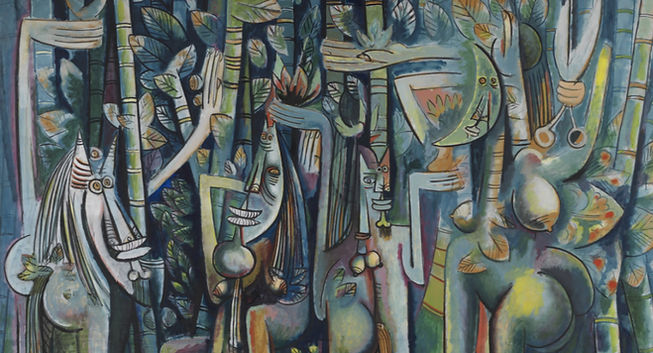
The morose beauty of The Jungle (1944), with all its spirit and big feet and crooked scissors and the shoots of sugarcane and those monstrous, wounded people in the night, is a clamorous gift to the world. It is a revelation achieved at the mid-point of life’s journey, the culmination of Lam’s return by another boat to the same island, this time with his eyes geared toward history and his brush set on the future.
This is the Wifredo Lam known to the general public. The Lam of Santeria and the legacy of slavery manifested into sharpness, the nauseating whorls of the tropics, suggestive and spiritual, the Lam who understood the art of Europe. But he also understood that even its most surreal metaphors fell short of describing the absurdity of his island. Its poverty was a poetry to him, a stark contrast to the gilded boulevards of the old Empire, and in that confusion it re-emerged as a challenge—a obligation to reconcile modernity with the ghosts of home, the rational with the absurd, the haunting of the past with the exquisiteness of what lay ahead.
.jpg)
